PREUßEN
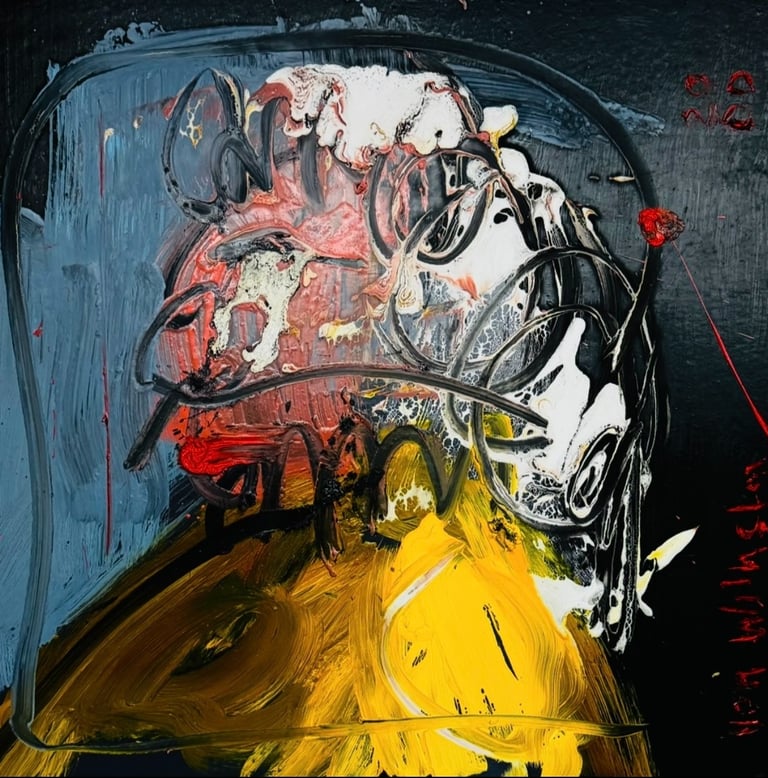
“Prussia” is an ongoing artistic project that Esteban Velazquez von Wilhelm has been developing since his arrival in Germany more than a decade ago. Drawing upon his academic background as a historian, the artist seeks to unravel episodes of German history and, through new visual and conceptual codes, reconsider the validity and resonance of Prussian cultural heritage within enduring cultural paradigms.
Beyond its pictorial dimension, the project opens a discursive space where sociology and the psychology of art converge—inviting reflection on identity, memory, cultural legacy, multiculturalism, and integration.
Originally from Venezuela—the land once explored and scientifically reimagined by Alexander von Humboldt—von Wilhelm now undertakes a symbolic return journey. More than two centuries later, he re-examines Germany through his own artistic lens, engaging with its historical vestiges and their echoes in the present.
At the core of Prussia lies a central question: how does Prussia persist in the German and universal imagination? This inquiry forms the conceptual foundation and departure point for the artist’s ongoing exploration.
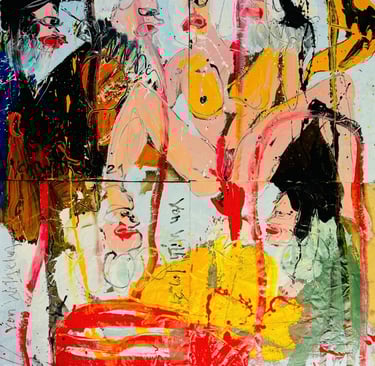
NEUER FÜRSTENZUG
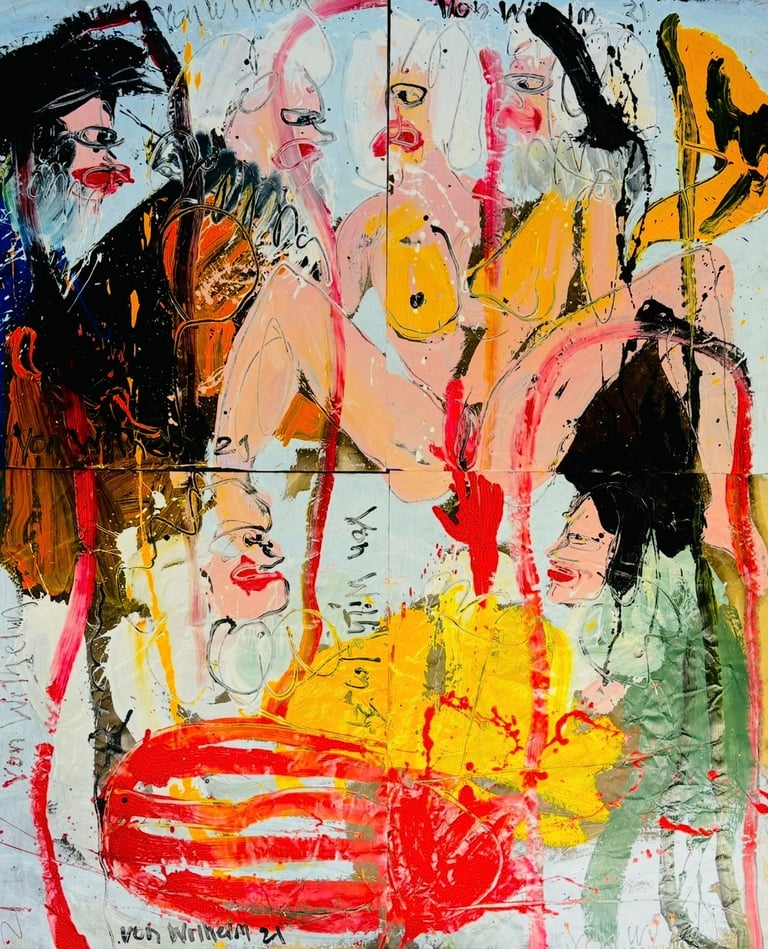
Presented to Schlösserland Sachsen, the ambitious project New Procession of the Princes proposes a contemporary reinterpretation of the monumental Meissen porcelain mural depicting the ruling princes of the House of Wettin. Initiated in 2016, the project revisits these Saxon rulers from a perspective that moves beyond traditional notions of heroism and chivalry, reimagining them instead in intimate, anecdotal scenes that resonate with the concerns of contemporary society.
In von Wilhelm’s reinterpretation, historical figures such as Augustus the Strong may appear as an asylum seeker, while his son might be portrayed as an expatriate taking part in a demonstration for social equality. Through these anachronistic juxtapositions, the artist constructs a bridge between past and present, questioning how power, identity, and representation evolve over time.
Once again, von Wilhelm engages with complex social realities through historical reference points, Baroque aesthetics, and his characteristic vigorous brushwork. In doing so, he offers—through the lens of a migrant and a scholar of German history—a reconstructed visual document that speaks powerfully to the cultural and social conditions of our own era.
Kontakt
Wir freuen uns auf Ihre Nachricht.
Impressum
Esteban Velazquez von Wilhelm
© 2022. All rights reserved.
VON WILHELM MANUFAKTUR
Badergraben 16 04808 Wurzen
E-Mail: info@vonwilhelmart.de
Tel.: +49(0)15776999372